
How Long Do You Homeschool a Kindergartener?
A Simple Guide for Parents
How Many Hours Should You Homeschool Kindergarten?
If you’re wondering, “How long do you homeschool a kindergartener?”, the short answer is that there isn’t one magic number of hours that every five or six-year-old needs.
A kindergarten homeschool day can be much shorter than a traditional school day because homeschooling gives you the opportunity to teach directly to your child’s needs instead of managing an entire classroom. A reasonable starting point for many families is around 1–3 hours of focused academic learning spread throughout the day, with plenty of reading, play, movement, conversation, creative activities, outdoor time, and practical learning happening outside those formal lessons.
The goal isn’t to recreate a six or seven-hour classroom at your kitchen table. The goal is to give your child meaningful opportunities to practice the foundational skills they need while protecting their natural curiosity and enthusiasm for learning.
Research on kindergarten schedules shows that full-day kindergarten can provide additional academic learning opportunities, but those findings concern classroom programs with many children and structured school environments; they shouldn’t be interpreted as a requirement that a homeschooled kindergartener sit at a desk for the same number of hours.
When you’re homeschooling, a short phonics lesson, a math activity, reading a story together, and practicing handwriting can be highly productive.
Then your child might learn even more while counting snacks, sorting laundry, drawing pictures, building with blocks, helping you cook, or looking for shapes outside. Kindergarten is less about clocking hours and more about building a strong foundation.

Why Homeschool Kindergarten Doesn't Need to Look Like Public School
One of the biggest mindset shifts for new homeschool parents is realizing that homeschooling kindergarten does not have to look like traditional kindergarten.
When you picture school, you may imagine a child sitting at a desk from 8:00 in the morning until mid-afternoon, completing worksheets and moving from one subject to another.
That model makes sense when one teacher has to guide a group of children through a predetermined schedule, but homeschooling gives you a completely different advantage: personalization.
If your child learns letters quickly, you don’t have to spend three weeks repeating something they already understand. If counting is difficult, you can slow down and practice it through games, toys, snacks, or movement. If your child becomes frustrated after twenty minutes of handwriting, you can stop, take a break, and come back later.
That flexibility is one of the reasons many families choose homeschooling in the first place.
Research into early childhood routines also highlights the importance of predictable routines while recognizing that young children experience learning through a mixture of structured and child-directed activities.
Think of your homeschool day as a rhythm rather than a stopwatch. You want enough consistency that your child knows what comes next, but enough flexibility that learning can follow your child’s attention, energy, interests, and developmental needs.
When you remove the pressure to imitate school, kindergarten homeschooling can become much more enjoyable for both parent and child.
What Should a Kindergarten Homeschool Day Include?
A successful kindergarten homeschool day usually combines several types of learning rather than relying entirely on worksheets or formal lessons.
At this age, foundational academics matter, but so do communication, fine-motor development, independence, problem-solving, creativity, movement, and social-emotional skills.
A simple day might include a short phonics or reading lesson, shared reading with a parent, a math activity, handwriting or drawing practice, a science or nature activity, and plenty of time for play. You don’t necessarily need to complete every subject every day.
For example, you might focus heavily on reading and math Monday through Thursday and use Friday for art, nature, games, library time, review, and activities your child particularly enjoys.
The important thing is that your child gets repeated opportunities to practice foundational skills without feeling as though learning is a never-ending list of assignments.
Even classroom kindergarten schedules have historically included combinations of reading, writing, mathematics, science, social studies, music, movement, centers, creative activities, and child-directed experiences.
At home, you can blend these experiences even more naturally. A trip outside can become science. Baking can become math. Reading a picture book can become vocabulary practice. Drawing cute things can become fine-motor development and storytelling.
When you think broadly about what counts as learning, you may discover that your child is learning far more than you initially realized.
Reading and Language Arts
Reading is one of the biggest priorities for kindergarten, but reading instruction doesn’t have to mean sitting down with a workbook for an hour every morning.
Young children benefit from hearing language, discussing stories, learning letter-sound relationships, practicing phonemic awareness, recognizing common words, developing vocabulary, and having opportunities to experiment with writing.
You might spend fifteen or twenty minutes on a focused phonics activity and then spend another fifteen minutes reading a favorite story together.

You can point out letters on signs while you’re driving, play rhyming games in the car, clap syllables, ask your child what they think will happen next in a story, or let them help write a grocery list.
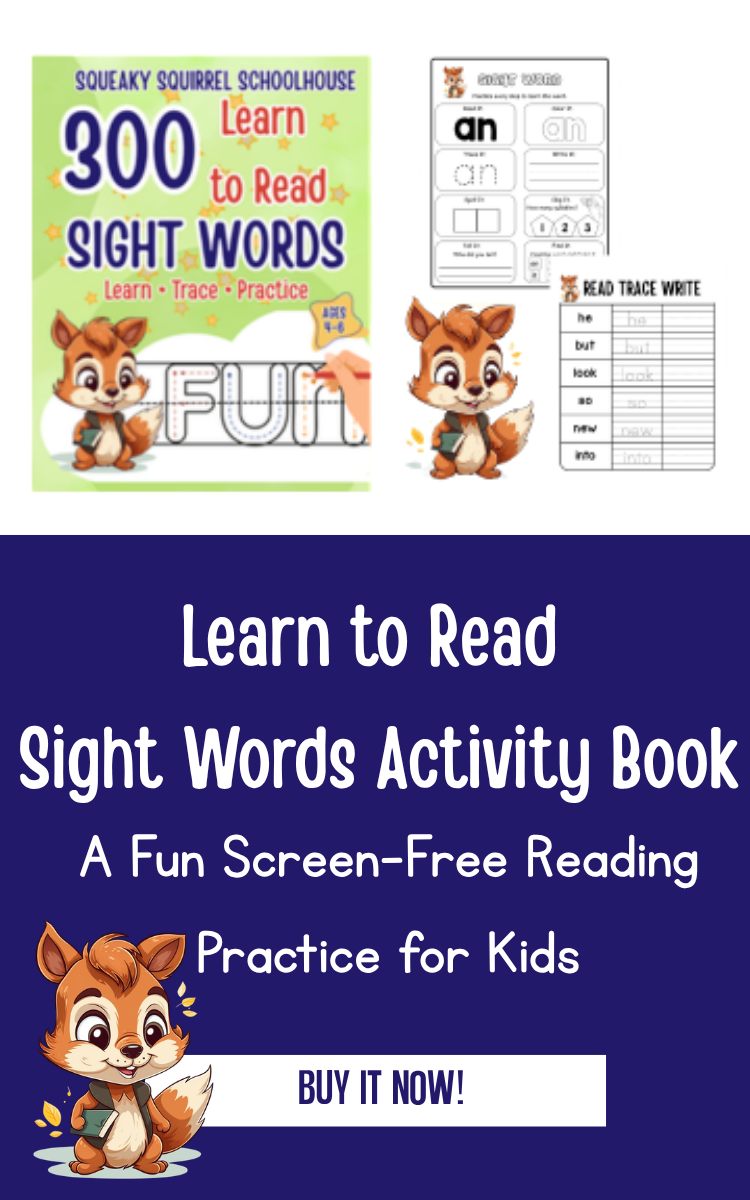
These seemingly ordinary moments can become valuable language experiences. If you’re using a sight-word activity book, you can practice a handful of words at a time rather than expecting your child to memorize dozens in one sitting.
The key is repetition without boredom. A child who recognizes a word today may need to encounter it many more times before it becomes automatic, and that’s perfectly normal.
The National Center for Education Statistics has documented how heavily reading and language arts feature in kindergarten classrooms, demonstrating that literacy is a major part of the kindergarten experience.
For homeschool parents, the opportunity is to make literacy personal. Choose stories your child loves, talk about characters, let them draw their own pictures, make silly rhymes, and celebrate small victories.
A child who associates reading with warmth, curiosity, and success is building something much more valuable than a completed worksheet.

Math and Early Number Skills
Kindergarten math should be hands-on, visual, and connected to everyday life. Children are developing concepts such as counting, number recognition, comparing quantities, patterns, sorting, shapes, simple addition and subtraction, measurement, and early problem-solving.
Instead of treating math as a stack of worksheets, look around your house for opportunities to practice. Ask your child to count five apples, sort socks by color, compare which pile has more blocks, find circles in the kitchen, create a pattern with toy cars, or help measure ingredients while baking.
You can use buttons, LEGO pieces, cereal, coins, toys, or household objects as manipulatives. The goal is for children to understand what numbers mean rather than simply memorize how to write them.
Research from the federal Early Childhood Longitudinal Study found that kindergarten classrooms commonly practiced activities such as counting aloud, calendar-related mathematics, number-quantity correspondence, and other foundational mathematical concepts.
That gives homeschool parents a useful clue: kindergarten math can be simple and practical. You don’t need an elaborate classroom. You need opportunities for your child to see, touch, compare, count, describe, and solve. If your child enjoys worksheets, use them.
If your child learns better by moving around, turn math into a game. If your child loves animals, count toy animals.
If they love cooking, measure ingredients. When math becomes something children can see and experience, abstract numbers begin to make much more sense.
Should Kindergarten Homeschooling Take All Day?
No, homeschooling kindergarten does not need to be an all-day academic event.
This is one of the most important things parents should understand before they begin. A traditional full-day kindergarten schedule includes much more than direct instruction, including transitions, classroom management, group activities, lunch, recess, centers, independent work, routines, and other experiences.
This is one of the most important things parents should understand before they begin. A traditional full-day kindergarten schedule includes much more than direct instruction, including transitions, classroom management, group activities, lunch, recess, centers, independent work, routines, and other experiences.Lorem ipsum dolor sit amet, consectetur adipiscing elit. Ut elit tellus, luctus nec ullamcorper mattis, pulvinar dapibus leo.
A homeschool parent working one-on-one with a child can accomplish a focused lesson much more efficiently. Research comparing full-day and half-day kindergarten has found academic advantages associated with full-day programs, but the evidence comes from structured school settings and should not be turned into a universal hourly requirement for homeschool families.
Instead, consider your child’s total learning environment. Maybe you spend two focused hours on academics, then your child spends an hour building a fort, reads independently for twenty minutes, helps prepare lunch, spends time outside, and later plays a counting game.
Those experiences all contribute to development. Your child doesn’t stop learning when you put the pencil away.
In fact, some of the most meaningful learning may happen when your child doesn’t realize they’re being taught. The question isn’t, “Did we homeschool for six hours today?”
A better question is, “Did my child have meaningful opportunities today to practice important skills, explore something interesting, move their body, communicate, create, and enjoy learning?” That shift can dramatically reduce homeschool anxiety.
The Importance of Play and Hands-On Learning
Play is not the enemy of kindergarten academics. Play is one of the ways young children learn.
A child building a tower is exploring balance, spatial relationships, planning, and problem-solving. A child pretending to run a restaurant is practicing vocabulary, social interaction, counting, sequencing, and imagination. A child drawing a picture is developing fine-motor control while communicating ideas. A child playing outside is developing physical skills and observing the natural world.
Early childhood research has examined classroom environments that balance teacher-directed activities with child-directed choices, finding that different activity patterns create different opportunities for language, literacy, math, movement, and imaginative play.
This is especially helpful for homeschool parents because it means you don’t have to choose between “real school” and “just playing.”
You can intentionally create a balance. After a short reading lesson, let your child build with blocks. After math practice, go outside and look for shapes.
After handwriting, make something with play dough. After reading a story about animals, draw an animal habitat. This approach gives your child a chance to process information rather than immediately moving to another worksheet.
If your child struggles to concentrate for long periods, that doesn’t automatically mean you need more discipline or more work.
It may mean the lesson needs to be shorter, more interactive, or broken into smaller pieces. Kindergarten should build a love of learning, not teach children that learning means sitting still for hours.
A Sample Kindergarten Homeschool Schedule
A flexible kindergarten homeschool schedule might look something like this:
begin the morning with breakfast and a conversation about the day, followed by 15–30 minutes of reading or phonics.
Take a movement break, then spend perhaps 15–30 minutes on math using manipulatives, games, or a screen-free activity book.
After another break, you might read a picture book and talk about it, followed by handwriting, drawing, or another fine-motor activity.
Later in the day, you can add science, nature study, art, music, cooking, or a hands-on project depending on your child’s interests.
That predictability can make transitions easier.The exact schedule matters less than creating a predictable rhythm. For example, your child might know that after breakfast comes reading, after reading comes a snack, after snack comes math, and after math comes outdoor play.
That predictability can make transitions easier.
Research into kindergarten transition and family routines has found that daily routines can help organize family life and that major routine changes can affect children’s adjustment.
You can use that principle at home without creating a rigid timetable. Maybe your child is fascinated by a science experiment one morning. Let them explore it.
Maybe they’re tired and need a shorter academic session. Adjust. Maybe they’re eager to practice reading after dinner. Take advantage of that enthusiasm.
Homeschooling allows you to follow those moments instead of forcing every learning experience into a predetermined schedule. The best schedule is one your family can actually maintain.
Creating a Flexible Daily Rhythm
Instead of asking yourself, “What time should homeschool start and end?”, consider creating a sequence your child can recognize.Lorem ipsum dolor sit amet, consectetur adipiscing elit. Ut elit tellus, luctus nec ullamcorper mattis, pulvinar dapibus leo.
For example, breakfast can lead to morning reading, reading can lead to a snack, snack can lead to math, and math can lead to outside time.
After lunch, you might have quiet reading, creative activities, science, or free play. This structure provides consistency without making your child feel trapped by the clock. It also makes it easier to handle real life.
If you have an appointment one morning, you don’t have to panic because your homeschool schedule has been disrupted. You can simply move your learning rhythm to another part of the day
One advantage of homeschooling is the ability to customize the pace and environment around the child. A five-year-old who wakes up slowly may not be ready for a demanding phonics lesson at 8:00 a.m., while another child may be eager to learn first thing in the morning.
Pay attention to those differences. Your child’s energy, attention, personality, interests, and learning style can help you determine when lessons work best.
A flexible routine can also prevent the common homeschool trap of trying to complete every planned activity even when your child has clearly reached their limit.
Sometimes the wisest educational decision is to close the workbook, go outside, and try again tomorrow. Consistency is valuable, but flexibility is one of homeschooling’s greatest strengths.
How Many Days a Week Should You Homeschool Kindergarten?
Many homeschool families choose to do focused academic work four or five days a week, but kindergarten doesn’t have to mean five identical school days.
You could use Monday through Thursday for your core reading and math lessons and make Friday a lighter day focused on review, library books, art, nature, games, cooking, or activities your child enjoys.
Some families prefer shorter lessons spread across five days because their children respond well to daily repetition. Others prefer four stronger learning days with a flexible fifth day. There isn’t one universal schedule that guarantees success.
What matters is whether your child is receiving consistent practice and gradually developing the skills you’re targeting. Remember that homeschooling includes learning that doesn’t happen at the table.
Reading a bedtime story, visiting a museum, going to the library, exploring a park, playing educational games, helping with household tasks, and talking together can all contribute to development.
Your formal school schedule is only one part of your child’s education. If you have a week when everyone is tired, reducing the workload isn’t failure. If your child is fascinated by dinosaurs and spends three days researching them, that can become an opportunity for reading, writing, science, counting, drawing, and storytelling.
Homeschooling gives you room to turn interests into learning. The goal isn’t to maximize seat time; it’s to maximize meaningful learning opportunities.
What Skills Should a Kindergartener Learn?
A kindergarten homeschool program typically works on a broad collection of foundational skills.
Academically, parents often focus on letter recognition, phonics, early reading, vocabulary, handwriting, counting, number recognition, basic mathematical reasoning, shapes, patterns, measurement, science concepts, and an understanding of the world.
But kindergarten readiness is broader than academics. Children are also developing skills such as following directions, listening, communicating needs, completing simple tasks, using scissors and pencils, managing frustration, taking turns, cleaning up materials, and working independently for short periods.
These skills may not always appear on a worksheet, yet they can make a tremendous difference when a child moves into more advanced learning. A school-readiness approach should therefore look at the whole child.
Can your child listen to a short story? Can they identify some letters and numbers? Can they hold a pencil and attempt writing? Can they count objects? Can they follow a two-step direction? Can they express what they need? Can they transition from one activity to another?
These questions can be more useful than comparing your child to another five-year-old. Children develop at different rates, and one child may be ahead in reading while another is stronger in math, language, motor skills, or independence.
Your job isn’t to make every skill perfect immediately. Your job is to notice where your child is now and create gentle opportunities for growth.
How Do You Know If Your Kindergartener Is Ready?
Parents often worry that they will somehow miss something important.
What if my child isn’t ready? What if I start homeschooling and discover we’re behind?
Those concerns are incredibly common, but readiness isn’t a single switch that suddenly turns on. It develops across many areas. A child may know the alphabet but struggle with pencil control. Another child may have excellent vocabulary but not yet recognize many printed words. A third child may understand numbers but become frustrated when asked to write them.
That’s why looking at multiple areas of development is more helpful than focusing on one test or one milestone. You can observe your child during everyday activities. Ask them to tell you about a picture, count objects, identify shapes, recognize letters, listen to a story, follow simple instructions, draw something, or attempt to write their name. Don’t turn every observation into a test. Simply use it to understand where they are.
A school readiness challenge can be particularly useful because it breaks preparation into manageable daily activities rather than presenting parents with an enormous checklist.
Instead of spending hours wondering whether your child is ready, you can work through a few focused activities each day and observe what comes naturally and what needs additional practice.
The objective isn’t perfection before kindergarten. The objective is building confidence, familiarity, independence, and foundational skills.
What If Your Child Struggles to Sit Still and Learn?
If your kindergartener struggles to sit still for lessons, don’t assume that you need to force longer periods of concentration. Five-year-olds are active learners.
Many children need movement, frequent breaks, hands-on materials, and changes in activity to stay engaged. Try shortening the lesson rather than repeating the same instruction over and over.
A ten-minute phonics game may accomplish more than thirty minutes of frustration. You can practice letter sounds while jumping to cards on the floor, practice counting while tossing a ball, or practice sight words by placing cards around the room and having your child find them.
You can also use a “first-then” approach: first we do our short reading activity, then we build with blocks. This creates a clear expectation without turning learning into a battle.
Watch your child’s signals. Are they bored? Confused? Hungry? Tired? Overwhelmed? Do they need movement? Sometimes resistance isn’t a character problem at all; it’s useful information about the learning environment.
A child who refuses a worksheet may happily demonstrate the same skill with magnetic letters or a game. This is where homeschooling can be wonderfully flexible. You can change the method without changing the goal.
The goal is learning the skill, not completing a particular worksheet. Once you adopt that mindset, many difficult homeschool moments become opportunities to experiment with a different approach.
Making Kindergarten Homeschooling Fun
If you want your child to enjoy homeschooling, make room for curiosity, choice, movement, laughter, and creativity. You don’t need to turn every lesson into a circus, but learning shouldn’t feel like punishment either.
Let your child choose between two activities. Use stickers, manipulatives, drawing, games, puzzles, books, songs, movement, and simple crafts. Read silly stories. Make up ridiculous sentences using sight words. Have your child become the teacher and “teach” you how to count. Build letters with play dough. Go on a letter hunt around the house. Create a pretend grocery store and practice money, counting, and writing.
These activities may take more creativity than simply handing over a worksheet, but they can create memorable learning experiences. When children enjoy an activity, they’re often more willing to repeat it, and repetition is important when developing foundational skills. The goal isn’t to entertain your child every second. It’s to make learning feel meaningful.
If a lesson is boring, change the format. If a concept is difficult, make it concrete. If your child succeeds, celebrate the effort. You want your child to begin thinking, “I can learn this,” rather than, “I’m bad at school.”
That confidence becomes incredibly valuable as academic expectations increase in later grades. Kindergarten is the beginning of a long educational journey. You don’t need to rush through it.
How the Free 7-Day School Readiness Challenge Can Help
If you’re a parent preparing a child for kindergarten—or a homeschool parent wondering whether your child has the foundational skills they need—the Free 7-Day School Readiness Challenge can be a simple place to begin.
Rather than trying to plan an entire kindergarten curriculum overnight, you can use seven days of focused activities to practice important early-learning skills and get a better picture of what your child already knows. The challenge can also help parents create momentum. Sometimes the hardest part isn’t teaching; it’s figuring out where to start.
A seven-day format gives you a small, manageable starting point. You can dedicate a short period each day to an activity and then observe your child’s confidence, attention, strengths, and areas that may need more practice. It can also help homeschool parents avoid the temptation to overdo kindergarten preparation.
You don’t need to buy twenty workbooks and spend hours every day trying to make your child “ready.” Start with the basics. Build gradually. Keep activities positive.
Squeaky Squirrel Schoolhouse Free 7-Day School Readiness Challenge digital download can be offered as a helpful resource for parents who want simple activities they can use at home. It fits naturally alongside reading aloud, play, hands-on math, creative activities, and everyday learning.
Think of it as a gentle seven-day jump-start rather than a test your child must pass. The purpose is to help parents feel more organized and confident while giving children opportunities to practice foundational school-readiness skills.
How Parents Can Use the 7 Day School Readiness Challenge at Home
The easiest way to use a seven-day challenge is to keep each activity short and positive. Choose a consistent time of day when your child is usually alert and cooperative.
You might do the activity after breakfast, before lunch, or during a dedicated morning learning period. Don’t worry if your child doesn’t finish every activity exactly as planned. The challenge is a tool, not a test. If your child loves an activity, repeat it. If something causes frustration, simplify it or take a break.
You can also use the challenge as an observation tool. Write down which activities your child completes independently, which require assistance, and which skills seem particularly enjoyable or difficult. By the end of seven days, you’ll have more information about your child’s current strengths and areas for growth. This is much more useful than simply asking, “Is my child ready for kindergarten?”
You may discover that your child has excellent number skills but needs additional letter practice. Or perhaps reading comes easily while fine-motor activities are frustrating. That information can help you decide what to emphasize in your homeschool routine.
Most importantly, keep the atmosphere encouraging. Five- and six-year-olds don’t need to feel as though every activity is an evaluation. They need opportunities to try, make mistakes, practice, and experience success.
Download the free 7-day School Readiness Challenge, print it or use it digitally, and make it part of a relaxed learning routine rather than another source of pressure.
Should Homeschool Parents Follow a Strict Curriculum?
A curriculum can provide helpful structure, but homeschool parents don’t necessarily need to follow a rigid minute-by-minute plan for kindergarten. Some families love having a complete curriculum that tells them exactly what to teach.
Others prefer combining books, printables, library resources, hands-on activities, educational games, and real-world experiences. Both approaches can work. The important question is whether your approach gives your child regular opportunities to develop the foundational skills you’re targeting.
If you use a curriculum, don’t be afraid to adjust it. Skip something your child has already mastered. Spend extra time on something that is difficult. Replace a boring activity with a hands-on version. Take a break when needed. A curriculum should be your tool, not your boss. This is especially important with kindergarten because children can vary significantly in their developmental readiness and interests.
One child might be eager to read independently while another needs more time with phonemic awareness. One child may love math worksheets while another learns numbers best through games.
Homeschooling allows you to customize the path. The more you observe your child, the better you can make those adjustments. You can use the free 7-day school readiness challenge as a starting point, identify areas that need attention, and then build a simple weekly routine around those skills.
Over time, your homeschool can become a combination of structured lessons and organic learning. That balance often makes the experience easier for the parent and more engaging for the child.
Common Kindergarten Homeschooling Mistakes to Avoid
One of the biggest mistakes parents make is trying to do too much too soon. Kindergarten doesn’t require a giant stack of worksheets every morning.
Another common mistake is comparing your child to other children. You may see a six-year-old online reading chapter books and wonder whether your child is behind, but social media rarely shows the complete picture. Children develop at different rates, and one child’s strength doesn’t define another child’s potential. Parents can also make the mistake of turning every moment into a lesson.
Sometimes your child should simply play. Sometimes they should draw without being corrected. Sometimes they should look at a picture book without being quizzed afterward.
Another mistake is abandoning a concept because the child doesn’t understand it immediately. Foundational skills often require repetition, different explanations, and practice over time. Finally, don’t forget to take care of yourself. Homeschooling a young child can be demanding, especially when you’re trying to balance education with household responsibilities and everyday life. A sustainable homeschool is better than an exhausting one.
Create realistic expectations, use resources that save you preparation time, and remember that progress doesn’t always happen in a straight line. If you have a difficult Tuesday, you can start fresh Wednesday.
Your child’s education is a marathon, not a race. You don’t need to create the perfect homeschool. You need to create one that your family can realistically enjoy and maintain.
Keep Kindergarten Simple, Flexible, and Fun
So, how long do you homeschool a kindergartener?
For many families, somewhere around one to three hours of focused academic work can be a practical starting point, with learning continuing naturally throughout the rest of the day through books, play, conversations, chores, outdoor exploration, games, creative activities, and real-life experiences.
There is no universal homeschool clock that every five-year-old must follow. Traditional full-day kindergarten research shows that longer school programs can provide additional instructional opportunities, but homeschooling is fundamentally different because the child receives individualized attention rather than participating in a classroom with a group of students.
The most important thing is to focus on what your child is learning rather than how many hours they are sitting at a table. Build a predictable rhythm, keep lessons developmentally appropriate, include plenty of movement and play, and adjust when your child needs a different approach.
If you’re preparing your child for kindergarten or simply want to see where they stand with foundational skills, the Free 7-Day School Readiness Challenge from Squeaky Squirrel Schoolhouse can give you a simple way to begin.
A small activity each day can help you build confidence, identify strengths, and discover areas where your child could use more practice. Kindergarten doesn’t have to be overwhelming. You don’t need a perfect classroom, a complicated schedule, or hours of worksheets.
You need consistency, patience, good resources, and a willingness to make learning part of everyday life. Keep it simple. Keep it positive. Keep learning fun.
Frequently Asked Questions
How many hours a day should I homeschool my kindergartener?
Many families can accomplish their focused kindergarten academics in approximately 1–3 hours per day, especially when lessons are individualized and include breaks. Reading, math, phonics, handwriting, and other structured activities can be divided into short sessions rather than completed all at once. The rest of the day can include educational play, reading, outdoor activities, practical life skills, art, music, and exploration. There is no universal number of homeschool hours that guarantees success, so pay attention to your child's attention span, developmental needs, and progress. A traditional school day contains many activities that don't involve direct academic instruction, so comparing your homeschool's "seat time" directly with a public school's schedule can be misleading. The goal should be meaningful learning rather than simply keeping a child at a desk for a certain number of hours.
What should I teach my kindergartener at home?
Core kindergarten areas commonly include early reading and phonics, writing, math, science, social studies, physical development, creative activities, and social-emotional skills. Reading and math generally deserve consistent attention because they provide foundations for later learning. You can supplement formal lessons with picture books, games, nature walks, crafts, cooking, puzzles, drawing, music, and hands-on activities. Your child doesn't need to complete a formal worksheet for every subject every day. A balanced weekly routine can provide repeated practice while leaving room for curiosity and play.
Is two hours of homeschool enough for kindergarten?
For many children, two hours of focused academic instruction can be plenty, particularly when lessons are personalized and broken into manageable sessions. A child might spend twenty minutes reading, take a movement break, complete twenty minutes of math, have a snack, and then spend another twenty minutes on handwriting or a hands-on activity. Learning doesn't stop when formal lessons end. Reading a story, helping measure ingredients, counting objects, building with blocks, playing outside, drawing, asking questions, and exploring nature all provide learning opportunities. Instead of judging your homeschool by hours alone, look at whether your child is steadily developing important skills and maintaining a positive relationship with learning.
How can I tell if my child is ready for kindergarten?
Look at the whole child rather than one specific academic skill. Consider whether your child can listen to a short story, communicate ideas, follow simple directions, recognize some letters and numbers, count objects, attempt writing or drawing, use basic fine-motor tools, and participate in activities for short periods. Independence and social-emotional development also matter. A 7-Day School Readiness Challenge can give parents a practical way to practice several foundational skills while observing what comes easily and what may need more attention. Remember that readiness develops over time, and children don't all reach milestones on exactly the same schedule.
Where can I get the free 7-Day School Readiness Challenge?
Parents can use the Free 7-Day School Readiness Challenge digital download from Squeaky Squirrel Schoolhouse as a simple way to begin preparing for kindergarten or strengthening foundational skills at home. A seven-day challenge can make preparation feel much less overwhelming because you’re focusing on one day at a time rather than trying to plan an entire school year. Use the activities at your child’s pace, celebrate progress, and repeat activities when additional practice is helpful. It can be especially useful for parents who want a structured starting point without turning kindergarten preparation into an all-day academic routine.
