Sight Words?
A Parent’s Guide to Helping Kids Learn to Read
Learning to read is an exciting milestone, but for many parents, the journey can feel overwhelming. You may hear teachers talk about sight words, high-frequency words, Dolch words, or Fry words and wonder:
What exactly are sight words, and why are they so important?
The good news is that sight words don’t have to be difficult or boring to learn.
With short, consistent practice and plenty of encouragement, children can gradually recognize common words quickly and confidently—helping them become stronger, more fluent readers.
In this parent-friendly guide, we’ll explain what sight words are, why they matter, when children should start learning them, and fun ways to practice at home.
What Are Sight Words?
Sight words are words that children learn to recognize quickly and automatically when they see them.
Instead of stopping to sound out every letter, a child eventually recognizes the word almost instantly.
Common examples include:
- the
- and
- is

Many sight words appear frequently in children’s books and everyday reading. Learning these words can make reading sentences much easier because children don’t have to spend as much time decoding every individual word.
Sight Words vs. Words Children Can Sound Out
One important thing for parents to understand is that not every sight word is necessarily impossible to sound out.
Some common words follow regular phonics patterns. Others have unusual spellings or contain parts that don’t follow the phonics rules a beginning reader has learned.
For example, a child may be able to sound out a word such as cat using basic phonics skills. But recognizing frequently used words such as the or said automatically can make reading much smoother.
The goal is not to replace phonics with memorization. Instead, sight-word practice works best alongside phonics instruction.
Why Are Sight Words Important?
Imagine a beginning reader trying to read this sentence:
“I can see the dog.”
A child who has to stop and decode every word may read very slowly:
“I… can… see… the… dog.”
As children become familiar with common words, they can recognize them more automatically.
This helps them:
Read More Fluently
Automatic recognition of common words allows children to spend less mental energy figuring out individual words.
That can help reading sound more natural and smooth.
Build Reading Confidence
Success matters.
When children recognize words they have practiced before, they can feel proud of themselves. Those small victories can encourage them to keep reading.
Focus More on Meaning
Reading isn’t just about identifying words. It’s about understanding the story or information.
When common words become automatic, children can devote more attention to what they’re actually reading.
When Should Children Start Learning Sight Words?
The more words children recognize automatically, the more independently they may be able to read simple books, instructions, stories, and activities.
When Should Children Start Learning Sight Words?
There isn’t one exact age when every child should begin learning sight words.
Many children are introduced to simple high-frequency words during preschool, pre-kindergarten, and kindergarten, while others begin later or earlier depending on their development and reading instruction.
A child may be ready to begin practicing simple sight words when they are:
- Interested in books and letters
- Beginning to recognize letters
- Learning basic letter sounds
- Starting to blend sounds together
- Able to recognize some familiar words
- Comfortable participating in short learning activities
Remember: children develop reading skills at different rates.
If one child knows 20 words while another knows five, that doesn’t necessarily mean one child is “behind.” The most important thing is consistent progress.
How Many Sight Words Should a Child Know?
There is no universal number of sight words every child must know at a particular age.
You may encounter different sight-word lists, including Dolch and Fry word lists. Schools and educational programs may also create their own lists based on the reading curriculum they use.
Rather than worrying about reaching a specific number quickly, focus on helping your child:
Recognize → Read → Understand → Use
A child who can confidently recognize a smaller group of words is often better served than a child who has memorized a large list without understanding how the words work in sentences.
Common Sight Words for Beginners
For young learners, it’s usually helpful to start with simple, frequently used words.
Here are some examples:
Early sight words:
- a
- I
- am
- is
- it
- me
- we
- can
- see
- the
- and
- to
- go
- you
- up
As children become more confident, you can gradually introduce additional words.
Fun Ways to Practice Sight Words at Home
Sight-word practice doesn’t need to feel like homework.
In fact, short and playful activities can be a great way to keep children engaged.
Sight Word Hunt
Write several sight words on cards and hide them around the room.
Ask your child to find a card, read the word, and bring it back.
For an extra challenge, have your child use the word in a sentence.
Use Sticky Notes
Write sight words on sticky notes and place them around your home.
For example:
- door: the
- table: is
- chair: my
- window: look
Every time your child walks past one, encourage them to read it.
Play Sight Word Bingo
Create simple bingo cards using words your child is learning.
Call out a word and have your child find and cover it.
This turns repetition into a game.
Make Sentences
Once your child knows several words, use them to create simple sentences.
For example:
I can see.
I like it.
We can go.
This helps children understand that words aren’t just things to memorize—they have meaning and work together to communicate ideas.
Practice With Books
Look for simple beginning-reader books that contain familiar high-frequency words.
Ask your child to find a particular word on the page.
You might say:
“Can you find the word ‘the’?”
Then celebrate when they find it.
Use Movement
Children don’t always need to sit at a table to learn.
Write sight words on pieces of paper and place them on the floor.
Call out a word and have your child jump to it.
You can also try:
- Sight-word hopscotch
- Word scavenger hunts
- Sight-word races
- Word matching
- Flashcard toss
- Word puzzles
Movement can make repetition more engaging for active learners.
How Long Should Sight-Word Practice Take?
For young children, short practice sessions are usually better than long ones.
Try starting with approximately 5–10 minutes at a time.
You can practice:
- Before reading a bedtime story
- During breakfast
- In the car
- After school
- During homeschool lessons
- While waiting at appointments
- During a quiet afternoon activity
The goal isn’t to make children sit through a long lesson.
The goal is to create frequent opportunities to see, say, read, and use words.
Should Parents Use Flashcards
Flashcards can be useful, but they shouldn’t be the only way children practice sight words.
A child may successfully identify a word on a flashcard but struggle to recognize that same word inside a book.
That’s why it’s helpful to practice words in different ways.
For example:
Flashcard:
“What word is this?”
Sentence:
“I can see the dog.”
Book:
“Can you find the word ‘the’ on this page?”
Writing:
“Can you write the word ‘the’?”
Using words in multiple contexts can help strengthen recognition and understanding.
What If My Child Struggles With Sight Words?
First, don’t panic.
Learning to read takes time, and children often need repeated exposure before a word becomes automatic.
If your child is struggling, try:
- Practicing fewer words at once
- Reviewing familiar words before introducing new ones
- Using games instead of worksheets every time
- Reading aloud together
- Using picture clues when appropriate
- Practicing words in simple sentences
- Celebrating small improvements
- Keeping sessions short
Most importantly, avoid turning reading practice into a battle.
A positive reading environment can help children associate books and learning with curiosity rather than frustration.
If you have ongoing concerns about your child’s reading development, talk with their teacher, reading specialist, or pediatric professional for individualized guidance.
A Simple Sight-Word Routine for Parents
You don’t need a complicated curriculum to get started.
Try this simple routine:
Step 1: Choose 3–5 Words
Don’t introduce a huge list at once.
Choose a handful of age-appropriate words.
Step 2: Look at the Words
Show each word and say it together.
Step 3: Practice Recognition
Mix the cards up and ask your child to identify the words.
Step 4: Use the Words
Create simple sentences using the words.
Step 5: Find the Words in a Book
Ask your child to look for the words while you read together.
Step 6: Review
Bring the same words back the next day.
Repeated exposure is important.
Make Sight Words Part of Everyday Life
One of the easiest ways to help children learn is to look for reading opportunities throughout the day.
Point out words on:
- Signs
- Food packages
- Store displays
- Children’s books
- Labels
- Games
- Calendars
- Notes
- Greeting cards
You can say:
“Look! There’s the word ‘the’ again.”
These small moments can help children understand that reading isn’t something they only do during school or workbook time.
The Biggest Tip for Parents: Keep It Positive
Learning to read is a process.
Some days your child may remember every word. Other days, they may forget a word they’ve known for weeks.
That’s normal.
Try to focus on progress rather than perfection.
Celebrate when your child recognizes a word independently. Celebrate when they sound out a new word. Celebrate when they pick up a book and want to read.
Those moments matter.
Final Thoughts
Sight words are an important part of early reading because they help children recognize common words quickly and build reading fluency.
But sight words are just one piece of the reading puzzle.
Children also need phonics, vocabulary, comprehension, listening skills, spelling, and plenty of opportunities to read.
The best approach is simple:
Keep practice short. Keep it consistent. Make it fun. Read together. Celebrate progress.
With patience and encouragement, those little words can become big steps toward becoming a confident reader.
Looking for an Easy Way to Practice Sight Words?
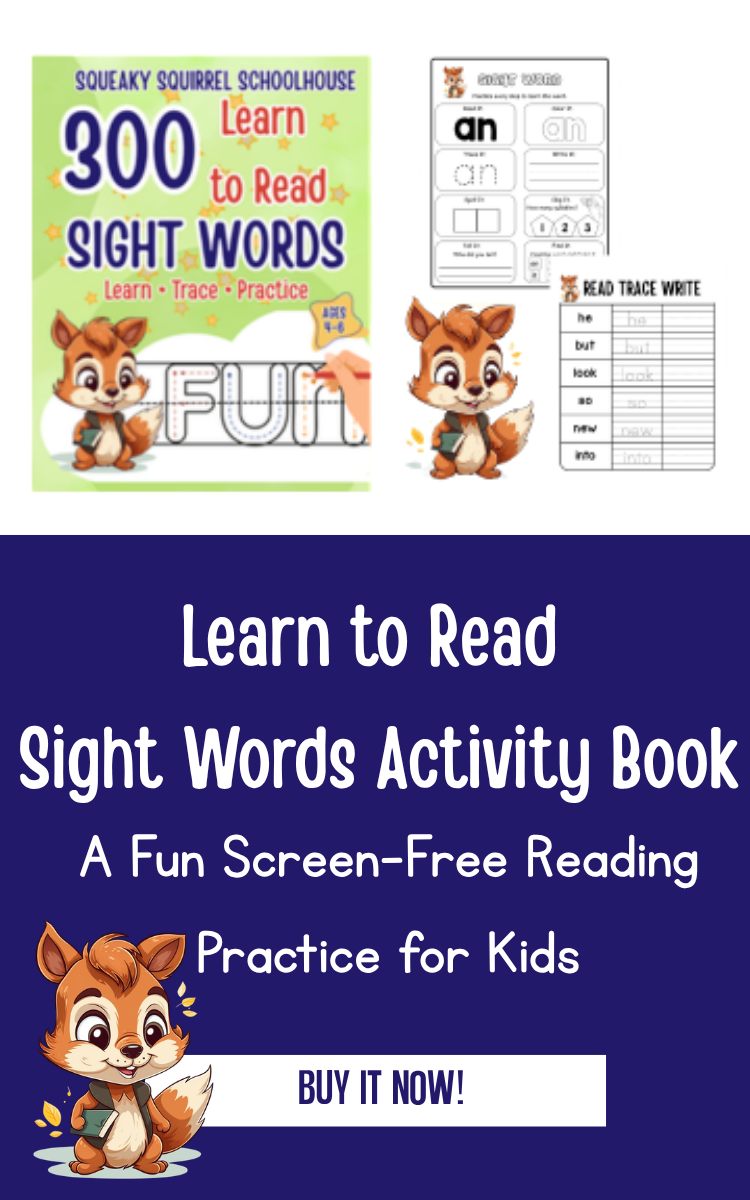
If you’re looking for a fun, structured way to help your child practice common words, a sight words activity book can give you ready-to-use activities without requiring parents to create lessons from scratch.
Look for activities that combine word recognition with tracing, matching, reading, writing, coloring, and simple sentence practice so children can learn while having fun.
Ready to make sight-word practice part of your child’s daily learning routine? Start with just a few words today—and build from there!
Frequently Asked Questions About Sight Words
Start with a small group of frequently used words and practice them regularly through games, books, flashcards, writing, and simple sentences. Keep sessions short and positive.
There isn’t one universal number. Expectations vary by school, curriculum, and individual child. Focus on steady progress rather than comparing your child with others.
The terms are often used interchangeably, although educators may distinguish between words that are simply frequent in text and words children are expected to recognize automatically.
Children benefit from developing automatic recognition of frequently used words, but memorization shouldn’t replace phonics instruction. Sight-word learning works best as part of a balanced approach to reading.
Try word hunts, bingo, matching games, scavenger hunts, movement games, sentence building, and finding sight words in favorite books.
A few minutes of practice each day can be more effective and enjoyable than one long session once a week. Consistency is key.
